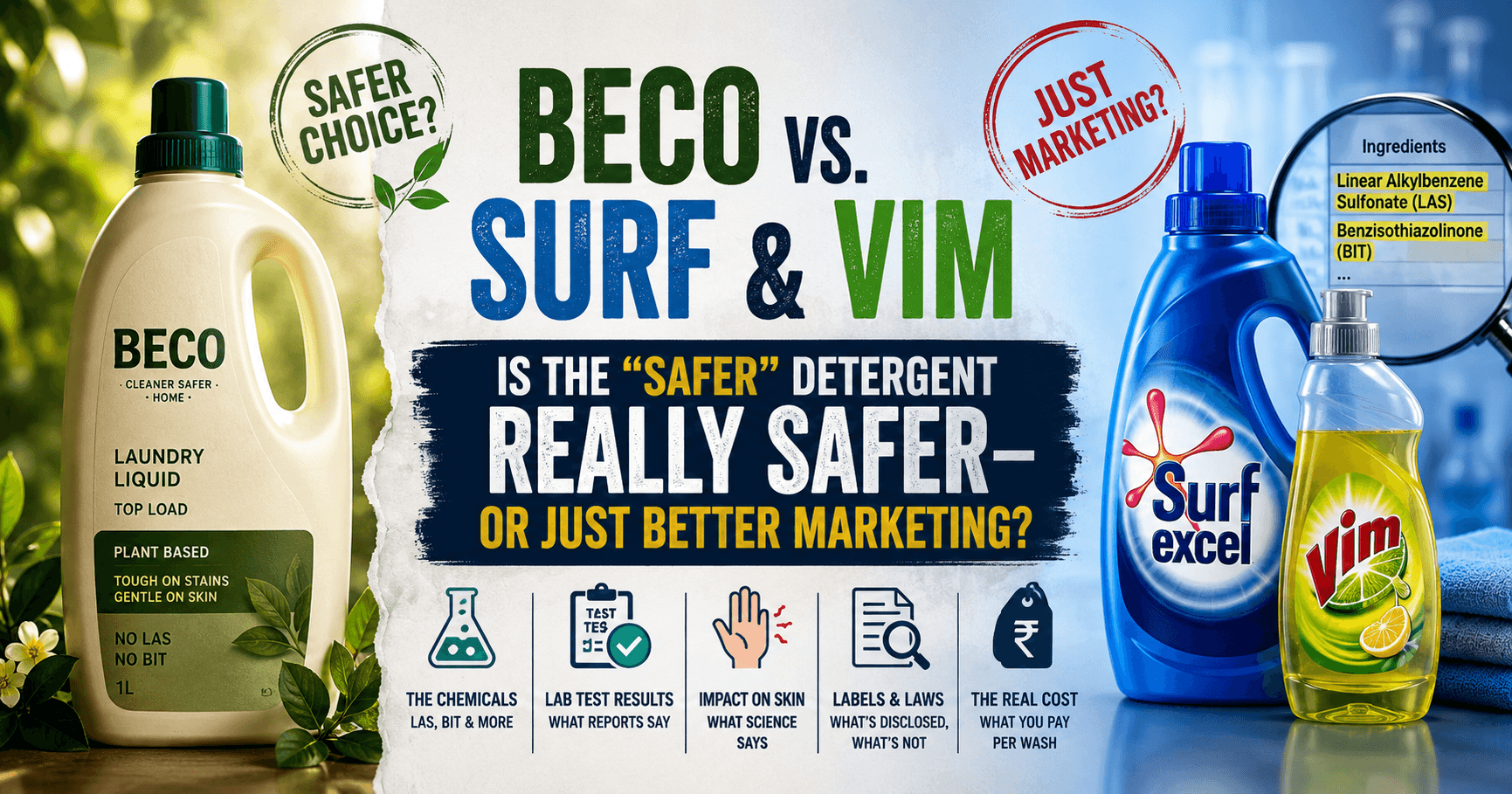
Methodology note: This article treats BECO's #WarOnWhatsHidden campaign as a hypothesis to test, not a verdict to accept. The distinction between detection, hazard, and risk is kept separate throughout.
1. The Question Everyone Should Be Asking
You probably know what is in the food you buy. You might even know what is in your face wash or shampoo. But do you know what is in the detergent you use on your clothes and dishes?
That is the question BECO's campaign forces into the open. In ordinary household life, most people trust the brand on the bottle and never think about the chemistry inside it. BECO is trying to change that by asking consumers to look past the front label and ask what the product is actually made of.
That is a legitimate consumer question. It is also where the analysis has to stay disciplined. A bottle can contain a chemical that has a real hazard profile and still not create a meaningful risk in ordinary use. The whole argument depends on dose, exposure, and the finished formulation.
2. What the Controversy Is Really About
The campaign centers on two ingredients most consumers would never name from memory:
- LAS, or linear alkylbenzene sulfonate, a common anionic surfactant
- BIT, or benzisothiazolinone, a preservative with a recognized sensitization profile
Those two words matter, but they do not answer the full question by themselves.
Key distinction: a chemical being present does not automatically make a product dangerous. Presence, hazard, and real-world risk are three different things.
That is why the article has to separate three claims:
- The chemical was detected.
- The chemical can cause harm under some circumstances.
- The finished product, used normally, creates a meaningful health risk.
The first two are analytical and toxicological questions. The third is the harder one.
3. What the Lab Reports Actually Found
The strongest part of BECO's case is that it points to actual laboratory testing, not just vague brand claims. The results reported in the source material look like this:
| Product | LAS | BIT | What it means |
|---|---|---|---|
| Surf Excel Matic Liquid | ~10-18% reported, often summarized around ~14% | 277 mg/kg | The tested sample contained a substantial surfactant load and measurable BIT |
| Vim Dishwash Gel | ~8-15% reported, often summarized around ~12% | Not tested in the supplied report | The tested sample contained substantial LAS |
| BECO Laundry | <0.5% / not detected | <1 mg/kg | The tested sample showed much lower or undetectable levels of the target chemicals |
| BECO Dishwash | <0.5% / not detected | Not reported in the supplied material | The tested sample showed much lower or undetectable LAS |
Two things matter here.
First, these are sample-specific results. They tell us about the bottles tested, not every bottle ever sold under those brand names.
Second, the numbers are composition data, not disease data. They can tell us what is in a product. They cannot, by themselves, prove what that product does to a person's skin in ordinary use.
4. LAS Is Common, Useful, and Irritating at the Wrong Dose
LAS is not some exotic poison. It is a workhorse surfactant. Its job is to help water lift grease and dirt so the product cleans effectively.
That same chemistry also explains why detergent can irritate skin. Surfactants can disrupt the lipid layer of the stratum corneum, increase water loss, and make skin drier and more reactive over time.
The important point is that dose matters. A bottle containing LAS is not the same thing as bare hands absorbing LAS at the same concentration. Dilution, rinse-off, contact time, frequency, and skin condition all matter.
So the scientifically honest statement is not "LAS is harmless" and not "LAS is poison." It is this:
LAS is a legitimate irritant concern at the right exposure level, especially with repeated direct contact.
That is why dishwashing by hand matters more than a lot of marketing copy admits.
5. BIT Is the More Serious Signal
BIT is different from LAS. It is not there to clean; it is there to preserve the product.
That makes it more interesting from a safety perspective because BIT is a recognized sensitizer. In plain English, that means some people can become allergic to it after exposure and then react to smaller doses later on.
The key number from the supplied reports is 277 mg/kg, which equals 277 ppm or 0.0277%.
That sounds abstract, so here is the important comparison from the source material: one published screening-level exposure assessment for BIT in cleaning products used 0.035% as a level unlikely to induce sensitization under its assumptions. The Surf Excel sample's 0.0277% is below that screening value.
That does not prove safety for everyone. It does mean the simple slogan "277 ppm = dangerous" is too crude.
The better statement is:
- BIT is a real sensitization hazard.
- The measured concentration is not obviously extreme.
- The remaining question is how much reaches skin during normal use.
6. What Bare Hands Change
This is where the campaign becomes relevant to ordinary households, especially anyone washing dishes with bare hands and no gloves.
Laundry and dishwashing are not the same exposure scenario:
- Laundry: detergent is usually diluted, contacts fabric, then gets rinsed away
- Dishwashing: concentrated liquid can touch hands and sponges directly, over and over again
That second scenario is much more important for skin exposure.
Bare-hand dishwashing is the exposure scenario to take seriously
When gloves are not used, the hands are exposed to the detergent solution, wet surfaces, friction, heat, and repeated re-wetting in the same session. A person may also apply more concentrate to a sponge, squeeze that sponge repeatedly, and continue washing after the skin has already begun to feel tight or slippery.
This is not an argument that every bare-hand user will develop dermatitis. It is an argument that bare-hand washing creates a more direct and repeated exposure route than machine laundry. Gloves reduce contact; they do not make a harsh product harmless, and they are not always practical. But for people who wash dishes daily, have eczema, or already notice dryness and cracks, the difference between gloved and ungloved use is a meaningful part of the safety calculation.
Repeated wetting, friction, hot water, and cracked skin can do more damage than people expect. Over time, detergents can contribute to dryness, tightness, roughness, redness, scaling, and fissures. Once the barrier is damaged, the skin becomes more vulnerable to everything else that follows.
So when a person says, "My hands got dry after months of washing dishes," that is not a weird anecdote. It is biologically plausible.
7. What BECO's Own Story Does and Does Not Prove
BECO's strongest argument is not that it is "chemical-free." That phrase is meaningless for a liquid cleaning product.
What BECO appears to be saying is more specific:
- the tested samples did not show LAS
- the tested sample showed <1 mg/kg BIT
- the formulation uses plant-derived or coconut-based surfactants
- the products include enzymes and fragrance
That is a real formulation difference. It is also incomplete.
| What we know | What we do not know |
|---|---|
| LAS was not detected in the tested BECO sample | Exact surfactant identities and concentrations |
| BIT was below the reporting limit in the tested BECO sample | Full preservative system |
| The formulation uses a different surfactant system | Exact pH |
| Enzymes and fragrance are present | Exact fragrance composition |
| The tested sample differs materially from Surf Excel and Vim | Comparative finished-product skin testing |
Natural or plant-derived does not automatically mean non-allergenic. Some mild surfactants can still trigger contact allergy in susceptible people. So the smartest reading is not "natural = safe." It is "different chemistry may change the exposure profile."
8. The Formulation Questions BECO Still Leaves Open
BECO's campaign argues that consumers deserve to know what is hidden inside competing detergents. That principle should apply to BECO too.
The campaign materials identify what BECO says is absent or present at low levels in its tested samples: LAS was not detected or was below 0.5%, and BIT was below 1 mg/kg in the tested laundry sample. But a low result for two target chemicals is not the same thing as a complete ingredient list. The supplied material still does not provide the precise identities and concentrations of every surfactant, preservative, fragrance component, enzyme, solvent, builder, or pH-adjusting ingredient in the finished products.
The report therefore asks a series of questions that BECO's campaign should answer before presenting its formulation as categorically safer.
Does BECO replace BIT with another preservative?
We do not know. The tested BECO sample showed BIT, methylchloroisothiazolinone (MCI), and methylisothiazolinone (MI) below the reported detection limits. That is useful evidence about what was not detected in that sample. It does not establish that BECO uses no preservative at all.
A water-based liquid product with a long shelf life needs some microbial-control strategy. That strategy could be a different preservative, a preservation system using multiple ingredients, or a manufacturing and packaging approach that reduces contamination risk. Without a complete preservative list and concentrations, consumers cannot evaluate the replacement system.
Could one allergen have been replaced with another?
The report's concern is conditional, not conclusive. If BECO uses an alkyl glucoside such as decyl glucoside or lauryl glucoside, it may have replaced a stronger irritant profile with a generally milder surfactant while still retaining a documented possibility of allergic contact dermatitis in susceptible users.
That could still be a worthwhile trade-off. Lower irritation is not the same as zero allergy risk. The contradiction is that BECO asks consumers to scrutinize competitors' allergen and irritant profiles while offering too little formulation detail to scrutinize its own.
Another possible replacement: cocamidopropyl betaine
The same question applies if BECO's advertised coconut-based surfactant system includes cocamidopropyl betaine (CAPB). CAPB is generally regarded as a relatively mild surfactant, but contact allergy has been reported. In some cases, the more relevant allergens may be manufacturing impurities such as amidoamine rather than pure CAPB itself.
This does not make CAPB equivalent to LAS, and it does not prove CAPB is in BECO. It shows why a broad claim such as "coconut-based" is not enough for a meaningful skin-safety assessment. Consumers need the ingredient identity, concentration range, impurity controls, and finished-product testing.
Let's compare the enzymes
BECO advertises five bio-enzymes, but Surf Excel also lists enzymes in its product information. Enzymes can help break down proteins, starches, and fats, so their presence is primarily a cleaning-performance issue, not an automatic safety advantage.
Enzymes are biologically active proteins and can cause sensitization under some occupational exposure conditions. At the same time, the detergent literature does not support treating every enzyme-containing laundry product as inherently dangerous. Without the enzyme identities, concentrations, and finished-product exposure data, "five bio-enzymes" is neither a major safety positive nor a major safety negative.
What about builders?
The supplied product information for Surf Excel lists builders and supporting ingredients such as sodium carbonate, sodium aluminosilicate, sodium silicate, sodium sulfate, and sodium perborate, alongside surfactants and enzymes. These ingredients are not all inherently dangerous. Their relevance depends on concentration and formulation.
For example, sodium carbonate and sodium silicate can be irritating at sufficiently high concentrations, while sodium aluminosilicate mainly functions as a water-softening builder. Sodium perborate is an oxidizing and bleaching ingredient with its own hazard profile. The correct comparison is therefore not "Surf has more chemical names, so it is unsafe." It is a comparison of complete formulations under intended use.
Phosphate-free does not necessarily mean safer hands
BECO's phosphate-free claim may have environmental significance, but phosphate absence is not the main variable in hand dermatitis. The more relevant questions are surfactant identity and concentration, pH, solvent system, preservative, fragrance, frequency of contact, and finished-product irritation testing.
BECO deserves credit only to the extent that its phosphate-free formulation produces a demonstrated environmental benefit. It should not receive an automatic hand-safety advantage from that label alone.
SLS is not LAS
This distinction matters because BECO's "SLS-free" or "sulphate-free" claim does not, by itself, prove that it is LAS-free. SLS means sodium lauryl sulfate; LAS means linear alkylbenzene sulfonate. They are different surfactant families.
The evidence for BECO's low LAS level comes from the separate LC-MS laboratory result, not from the marketing phrase "sulfate-free." That is a good example of the wider problem: a technically true label can still leave consumers with a broader impression than the evidence supports.
What about fragrance?
BECO describes its fragrance as IFRA-compliant, naturally derived, and mild. Those descriptions may be reassuring, but IFRA compliance does not mean allergy-proof, and natural fragrance can contain recognized fragrance allergens.
The fair conclusion is that BECO's fragrance may be reasonably formulated, not that it cannot cause dermatitis. A complete assessment would require the fragrance allergen disclosure, concentration range, and finished-product patch or use testing.
BECO's own website provides an important clue
The report notes a customer review on BECO's laundry page describing a child's skin allergy after use. That is anecdotal and cannot establish that BECO caused the reaction. It could reflect an individual allergy, another exposure, or a product-use factor.
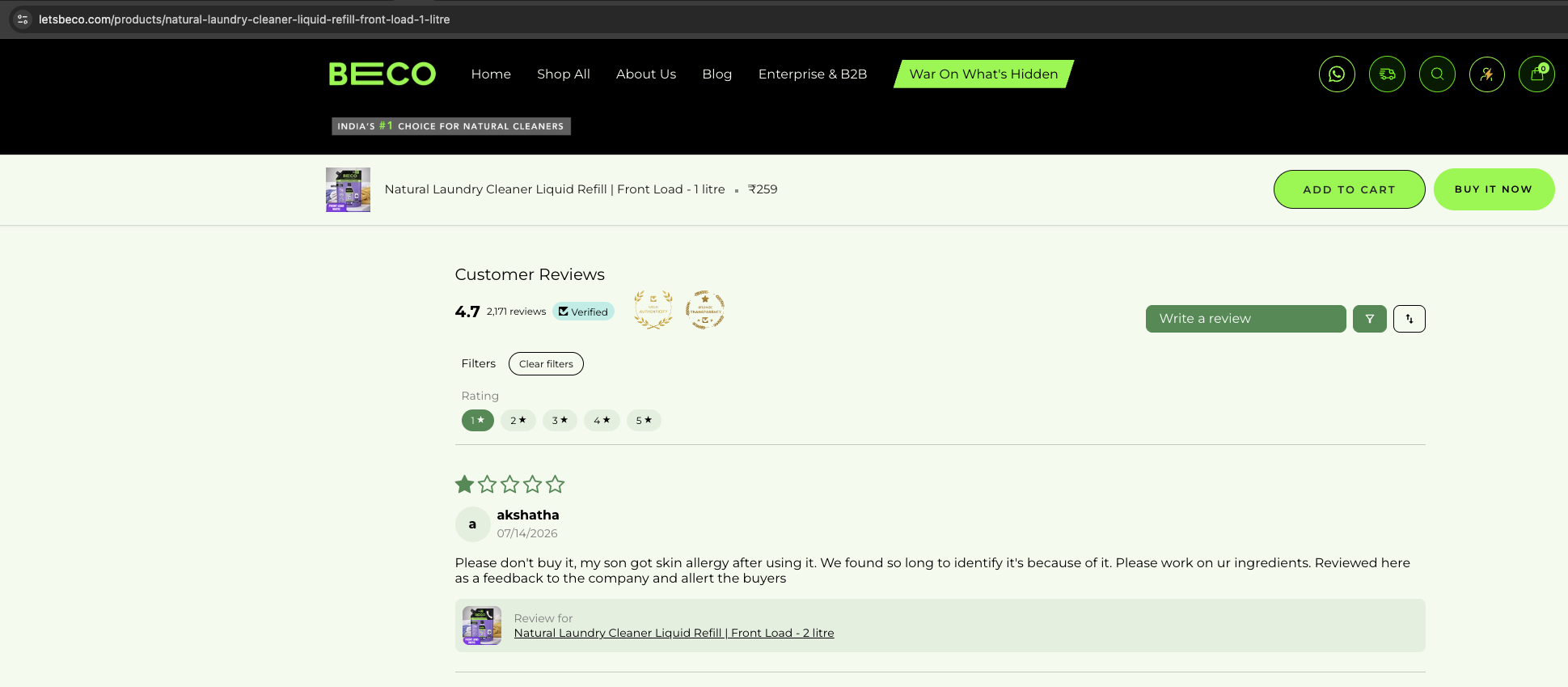
Evidence from BECO's own website: a one-star customer review reporting that the reviewer's son developed a skin allergy after using the product. This is a screenshot of a public website review, not an independently verified clinical case report.
But the review is still relevant to the campaign's larger claim: even a formulation marketed as safer can produce individual reactions. BECO should apply the same evidentiary humility to itself that it asks consumers to apply to Surf and Vim.
That creates a clear contradiction in the campaign's logic:
BECO is right to criticize competitors for making consumers guess about important ingredients. It should not ask consumers to trust BECO's safety story while leaving comparable parts of its own formulation undisclosed.
This is not a claim that BECO is hiding a dangerous ingredient. There is not enough evidence to say that. It is a transparency standard: if disclosure is the basis of the campaign, BECO should publish full formulation-level ingredient information, test methods, reporting limits, batch details, pH, intended-use dilution, and independent finished-product skin testing for both its laundry and dishwash products.
9. Transparency and Disclosure
This is where the article becomes bigger than BECO.
India's ordinary household detergent labels do not appear to follow the same full-ingredient disclosure model as the EU. The general Indian packaging framework focuses on items like manufacturer details, generic name, quantity, manufacturing information, MRP, and consumer-care information.
The EU approach is more transparent. Consumer detergent packaging there includes surfactant bands on the label and a more detailed ingredient sheet online.
| India | EU |
|---|---|
| General packaging declarations | Surfactant bands on-pack |
| No general EU-style full ingredient list for ordinary household detergents | Detailed ingredient information available online |
| Consumer protection and misleading-advertising rules still apply | More direct route for consumer inspection |
That means two things can be true at once:
- HUL may not be legally required to print every ingredient on the bottle.
- Consumers may still have a strong ethical reason to want more disclosure.
Not required to disclose is not the same thing as permission to mislead.
10. The Legal Fight in Context
The legal dispute matters because it shows where science and advertising start to diverge.
BECO's argument is essentially that it found chemicals in competitor products that consumers were not being told about. HUL's scientific objection, as described in the source material, is not simply "the lab result is fake." It is that a detected ingredient does not automatically prove that the finished product is harmful in normal use.
That is a stronger objection than a simple denial, and it is also the right scientific objection.
The right question is not whether a chemical has ever been linked to a hazard in the literature. The right question is whether this finished product, at this concentration, under normal intended use, creates a meaningful risk.
11. Is BECO Actually Gentler?
On the evidence supplied, the answer is: probably gentler for repeated bare-hand exposure, but not definitively proven safer overall.
Why that cautious answer?
- The tested Surf Excel sample had materially more LAS and measurable BIT
- BECO's tested sample had no detected LAS and <1 mg/kg BIT
- A different surfactant system likely changes irritation potential
- But the full replacement chemistry is not fully disclosed
- And there is no direct human finished-product irritation study in the supplied material
So the best scientific verdict is not "BECO is safe." It is:
BECO looks like a plausible lower-exposure option for the two chemicals at the center of the campaign, especially for frequent hand exposure.
That is a strong claim. It is also smaller than "proven safer in every respect."
12. What Does the Safer Choice Cost?
The economic part is important because a safer product that is wildly more expensive tells a different story from a safer product that is roughly price competitive.
The current prices in the source material suggest the gap is smaller than many people assume.
| Product | Approx. current price | Approx. cost metric |
|---|---|---|
| BECO Laundry Top Load 960 ml | ₹220 | ~₹229/L |
| BECO Laundry Top Load refill 1 L | ₹237 | ~₹237/L |
| Surf Excel Matic Top Load 1 L | ₹210-235 | ~₹210-235/L |
| BECO Dishwash 750 ml | ₹190-199 | ~₹253-265/L |
| Vim Lemon Gel 500 ml | ~₹125-135 | ~₹250-270/L |
If you translate that into actual use:
- a normal Surf Excel wash lands around the low-to-mid teens in rupees per wash
- a BECO laundry wash is often in the same neighborhood
- dishwashing can come out almost identical if the dose is similar
That is a big deal. It means the decision is not obviously "pay a lot more for peace of mind." In several cases, the price difference is surprisingly small.
13. Exposure Economics
This is where the numbers become very revealing.
Normalizing to 1 gram of product handled gives a simple comparison:
| Per 1 g product | Surf Excel | Vim | BECO |
|---|---|---|---|
| LAS | ~140 mg | ~120 mg | <5 mg |
| BIT | 0.277 mg | Not tested in the supplied report | <0.001 mg |
That means the tested BECO sample contains at least:
- 28x less LAS than the tested Surf Excel sample
- 24x less LAS than the tested Vim sample
- more than 277x less BIT than the tested Surf Excel sample
Those are product-content ratios, not disease-risk ratios. Risk is never that linear. But as a rough exposure story, the difference is real.
If someone repeatedly handles detergent every day for years, the cumulative amount of LAS and BIT in the product matters. The question is not just "what is in the bottle?" but "how much of this chemistry am I repeatedly putting in contact with my skin?"
14. So Is the "Safer" Detergent Really Safer?
Here is the cleanest verdict.
What BECO gets right
- The tested products really did differ.
- LAS and BIT were not marketing inventions; they are real chemicals with real literature behind them.
- The lower numbers in the BECO samples are meaningful.
Where BECO overreaches
- Lower LAS/BIT does not prove the whole formulation is safer.
- Natural or plant-based does not mean non-allergenic.
- Composition data is not the same thing as finished-product skin testing.
What consumers should conclude
BECO looks like a plausible lower-exposure alternative for the specific chemicals tested. That is not nothing. But "safer" is a broader claim than the supplied evidence can fully prove.
15. Key Takeaways for Consumers
If you are deciding what to buy or how to use it, the practical conclusions are narrower than the advertising language:
- Treat lower LAS and BIT as a meaningful formulation advantage, not proof that every aspect of BECO is safer.
- Give extra weight to the way you use the product. Daily bare-hand dishwashing is a more direct exposure route than machine laundry.
- Use gloves if practical, especially when washing for long periods, using concentrated product, or dealing with cracked, eczema-prone, or already irritated skin.
- Follow the dose and dilution instructions. More detergent does not necessarily mean cleaner dishes or clothes, but it does increase the chemical load handled by your hands.
- Rinse hands well, dry them, and use a plain moisturizer when repeated washing leaves the skin tight or rough.
- Stop using a product and seek medical advice if you develop persistent redness, itching, scaling, fissures, swelling, or a rash that returns after exposure.
- Do not treat "plant-based," "natural," or "chemical-free" as a complete safety assessment. Ask what the full surfactant, preservative, fragrance, and enzyme system is.
- Ask every brand, including BECO, for the full ingredient list, concentration ranges, test reports, reporting limits, and finished-product skin-safety data.
16. The Bigger Question
The most interesting part of this story is not whether one brand won a marketing fight.
It is whether consumers should have to guess at the chemistry of products they use on their skin and dishes every day.
BECO's campaign is strongest when it asks for transparency. It is weakest when it turns a real formulation difference into an all-purpose safety claim.
The final lesson is simple:
lower LAS and lower BIT are real advantages, but they are not the same thing as a universal safety guarantee.
The better consumer takeaway is not "trust BECO instead." It is "give consumers enough information to decide for themselves."
Evidence current as of August 30, 2026.
References
The laboratory values and product-price comparisons in this article come from the supplied campaign research pack, including the Scientific Deep Dive BECO Campaign report and the named LAS and BIT laboratory reports cited within it. The following published studies and regulatory material provide the external context for the skin-barrier, sensitization, and disclosure claims:
- Kein G, Gubauer G, Fitsche P. The influence of daily dish-washing with synthetic detergent on human skin. British Journal of Dermatology. 1992;127(2):131-137. DOI: 10.1111/j.1365-2133.1992.tb08045.x.
- Austoria AJ, Lakshmi C, Srinivas CR, Anand CV, Mathew AC. Irritancy potential of 17 detergents used commonly by the Indian household. Indian Journal of Dermatology, Venereology and Leprology. 2010;76(3):249-253. DOI: 10.4103/0378-6323.62963.
- The irritancy of hand dishwashing liquids on the skin. Annals of Dermatology. 1999;11(1):13-20.
- Aalto-Korte K, et al. Estimation of the safe use concentrations of the preservative 1,2-benzisothiazolin-3-one (BIT) in consumer cleaning products and sunscreens. Food and Chemical Toxicology. 2013. DOI: 10.1016/j.fct.2013.04.017.
- World Health Organization. WHO Guidelines on Hand Hygiene in Health Care. See the sections on detergent-related skin-barrier damage and hand-care measures.
- European Parliament and Council. Regulation (EC) No 648/2004 on detergents. See Annex VII for surfactant bands and ingredient-datasheet requirements.
- Fowler JF Jr, et al. Allergy to cocamidopropyl betaine may be due to amidoamine: a patch test and product use test study. Contact Dermatitis. 1997;37(6):276-281.
- Aerts O, et al. Allergic contact dermatitis caused by alkyl glucosides. Contact Dermatitis. 2014;71(3):155-160.